Goodyear to Test First Airless 3D Printed Tire on Autonomous Vehicle in Florida

As part of a project to support urban autonomous vehicle transportation, the city of Jacksonville, Florida will test the autonomous Olli shuttle fitted with Goodyear’s innovative 3D printed airless tires. The tire giant teamed up with Local Motors, creators of the first 3D printed electric shuttle; Beep, an autonomous mobility technologies provider; and the Jacksonville Transportation Authority (JTA), in what they are calling the first airless tire on autonomous shuttles for in-field use. This new partnership will make electric transportation even more sustainable as part of the JTA’s mission to transform and modernize the existing people-mover public system in the city center.
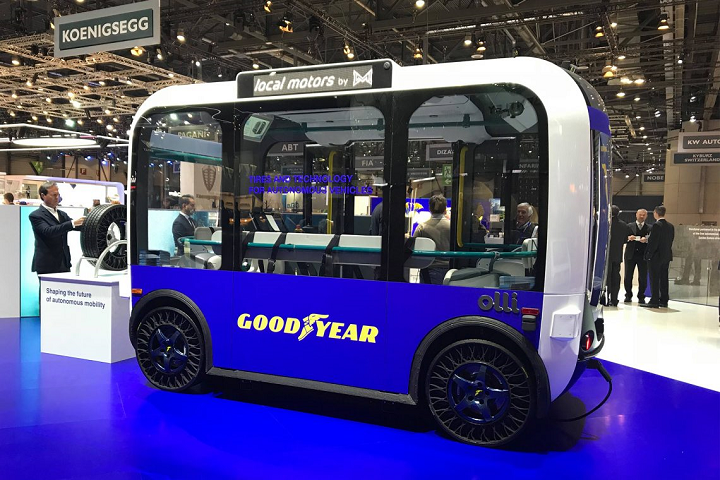
For the past three years, Goodyear and Local Motors have tested an Olli shuttle supported by the 3D printed non-pneumatic (airless) tires (NPTs) reaching several performance targets concerning load, speed, and durability. Later, in 2019, Goodyear pivoted its NPT concentration to on-road testing and a growing relationship with Local Motors, hoping to prove that non-pneumatic tires could become the industry standard in the coming years.
Furthermore, the urban transportation environment provides an ideal testing scenario for the alternative tire architecture given its lower speed and less variable travel paths. In fact, this latest testing phase in Jacksonville will reveal more about non-pneumatic tires than during the last few years combined, including how they can offer sustainable, maintenance-free, and longer-lasting options for electric shuttle vehicles. In addition, Goodyear and Local Motors will gather experiential data from the JTA, looking for viewpoints on ride comfort, noise, and other variables.
Goodyear Senior Program Manager of non-pneumatic tires Michael Rachita explained that “as mobility evolves, we feel that tires can transform the way we move and alternative airless architectures are ideal, particularly in the emerging autonomous transportation environment. This is an important milestone as we look to advance mobility today and as we look to introduce the first completely sustainable and maintenance-free tires by the end of the decade.”
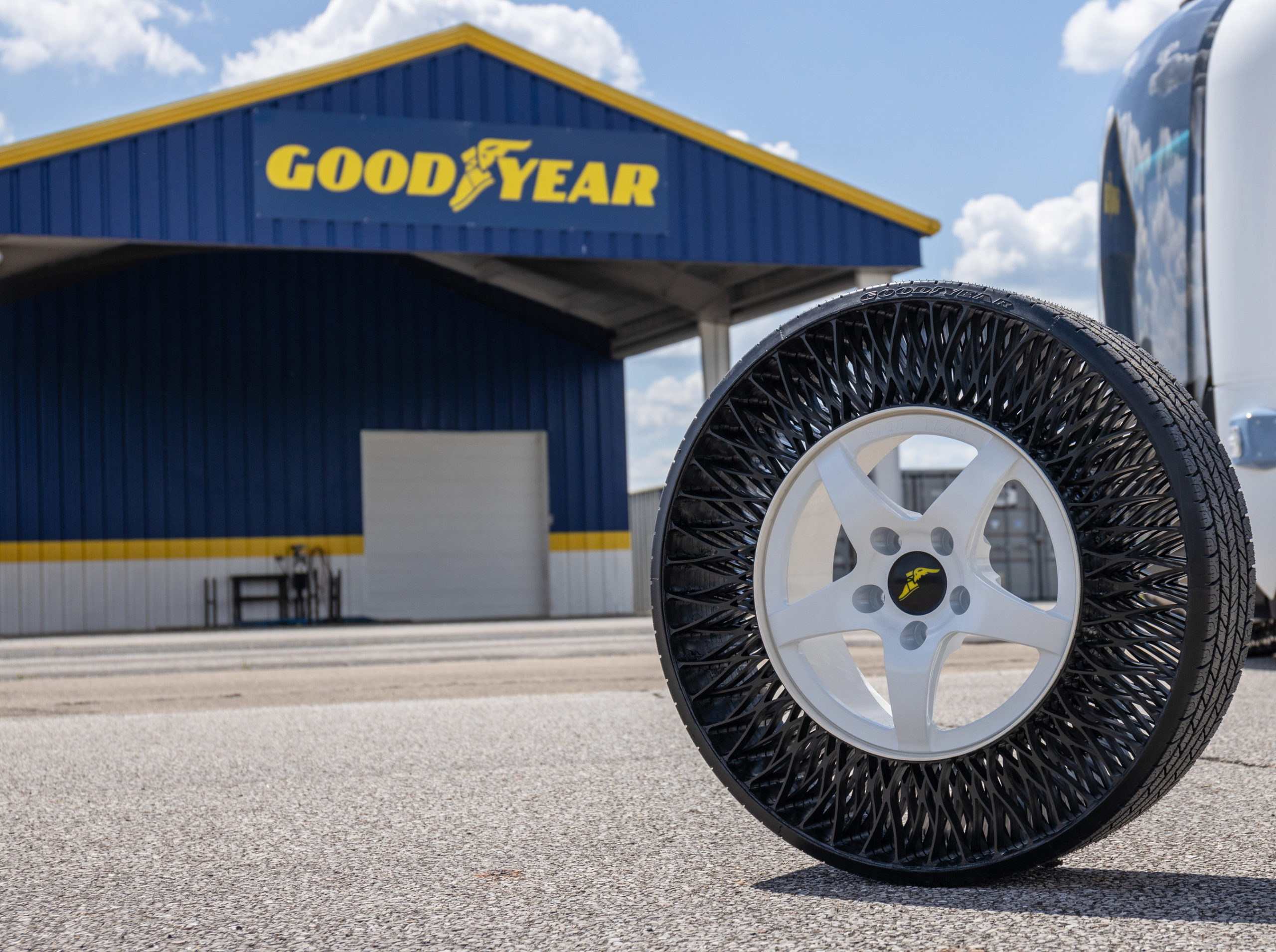
A Goodyear non-pneumatic (airless) tire (NPT). Image courtesy of Goodyear.
In September 2020, the JTA welcomed the Olli 2.0 autonomous vehicle from Beep, Local Motors by LM Industries, and Robotic Research into its JTA Test and Learn program. The plan was to have the Olli lead the next phase of the JTA’s Test and Learn activities at Florida State College at Jacksonville’s Cecil Center Campus and the JTA’s Armsdale Test and Learn facilities.
Olli is the fifth autonomous vehicle that the JTA has tested since it launched its Ultimate Urban Circulator program in 2017 to alter the existing Skyway APM system in the city center. The multiphase program includes the full conversion of the existing Skyway infrastructure and neighborhood expansions through ground-level connections, creating a 10-mile urban transit network. JTA CEO Nathaniel Ford Sr. described the collaboration as an example of how Jacksonville is leading the public transportation industry by developing autonomous vehicle mobility solutions.
Autonomous vehicles like the Olli will pave the way to shape the future of public transportation, not just in Jacksonville but nationally. The Olli 2.0 is equipped with Robotic Research’s AutoDrive autonomy kit, which uses the vehicular communication system vehicle-to-everything (V2X) technologies to provide driver-warning, driver-assist, and connected autonomous functionality in urban, mixed-traffic roadways as well as campus environments. Additionally, Robotic Research’s proprietary nSight family of products provides an end-to-end data collection-to-analysis pipeline to better enhance the future of autonomous vehicles and transportation. The shuttle will now be complete with Goodyear’s 3D printed NPT and wheel assembly.
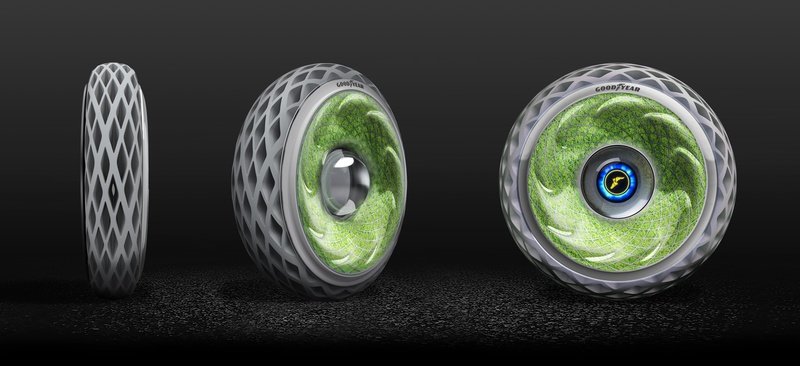
The Goodyear Oxygene airless tire. Image courtesy of Goodyear.
Tire giants Goodyear and Michelin have been leveraging 3D printing technologies for years, driving smart tire innovations. In 2017 Michelin revealed its Vision concept tire 3D printed using biodegradable recycled material. A year later, Goodyear followed with its Oxygene concept tire designed to support cleaner and more convenient urban mobility. These seemingly futuristic tires offer several advantages and solve the risks of flat tires and blowouts. However, they are still just concept tires, and the companies behind them expect to see a complete switch from consumers in decades. Still, any 3D printed, airless system designed with biomaterials has a lot of potential in the cars of the future. Although we won’t be driving these puncture-proof concept tires just yet, we might see them in autonomous vehicles like the Olli shuttle first.
Subscribe to Our Email Newsletter
Stay up-to-date on all the latest news from the 3D printing industry and receive information and offers from third party vendors.
Print Services
Upload your 3D Models and get them printed quickly and efficiently.











You May Also Like
Benelli Looks to 3D Printing for Gun Chassis
There’s a lot happening in the world of 3D printing guns. There is the ever-present danger of some people trying to print guns at home. Suppressors are one of the...
Outlaw3D: FBI Director’s 3D Printed Gun Gifts Destroyed in New Zealand
During a visit to New Zealand this July, FBI Director Kash Patel cut the ribbon on the bureau’s first standalone office in Wellington. At the same time, he presented senior...
OUTLAW3D: Singapore’s 3D Printing Service Bureaus Ask for Better Regulations on Gun & Vape Parts
Back in 2021, the Parliament of Singapore passed a law called the Guns, Explosives, and Weapons Control (GEWC) Bill, banning individuals without the appropriate licenses from owning digital blueprints for...
Lawmakers Reignite Effort to Block Online Sharing of 3D Printed Gun Files
Senator Edward Markey (D-MA) introduced a new bill in the U.S. Senate that would ban the online distribution of digital files used to 3D print firearms. The proposed legislation, called...